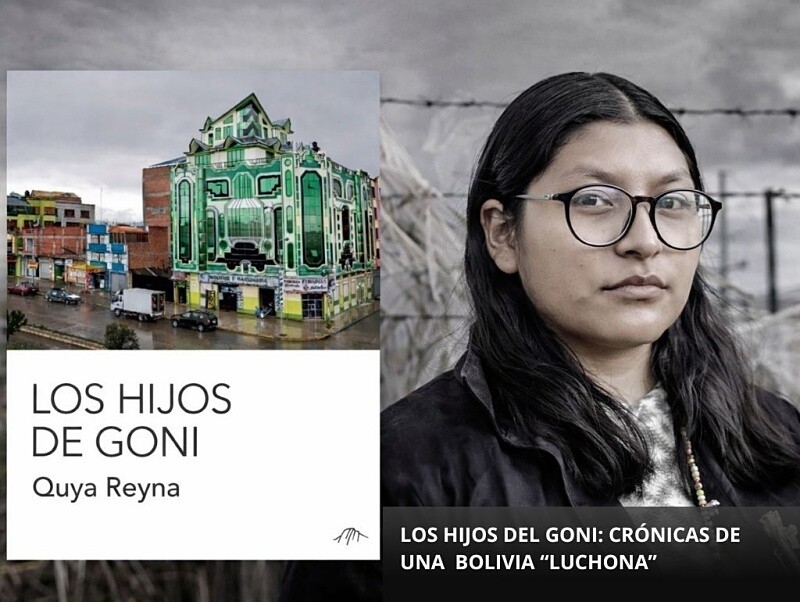
A new publishing house, Cerro Amarillo Ediciones, is born in this territory, dedicated to chronicle, essay, and Latin American thought. “The project had been in the making for a long time, but Quya's book was the trigger, the kickstart,” explains Videgaray, defining that first title as a true declaration of editorial principles. He does not renounce academia or other fields of power—fashion, music, art, media—but insists that all these spaces must be contested from a position of identity, not as a concession. The nine chronicles in the book can be read in about five hours, where surprise can be followed by tears and ultimately end with a smile. Faced with social pressure, political collapse, and international repudiation, Sánchez de Lozada resigned and fled to the United States, where he remains to this day. His departure marked a historical turning point: it revealed the exhaustion of the neoliberal model and paved the way for a new political cycle led by indigenous, labor, and popular movements, which culminated with the arrival of Evo Morales to the presidency in 2006. Cerro Amarillo Ediciones and its bet on Latin America Alejandro Bidegaray has been a bookseller and editor for almost fourteen years. The publisher proposes a brief catalog with a strong Latin American identity, aimed at a broad audience, in a context of crisis in the book industry and falling consumption. “The editor is an illusionist by definition,” he says, but he believes what he does is necessary. With limited print runs, small formats, numbered books, and Latin American photography on the cover, Cerro Amarillo bets on generating circulation for texts that today have no outlet. In this context, upcoming publications of chronicle and essay are announced, which dialogue with the present, political memory, and the cultural transformations of the continent, expanding the field opened by 'The Children of Goni' and reinforcing an editorial line that seeks to think of Latin America from its own voices. 'The Children of Goni', by Quya Reyna, dismantles myths, discusses identities, and proposes to think about El Alto without epic or victimization. Quya, in an interview with Sarai Amoroso, explains that the 2019 political crisis “placed” her in a place she perhaps did not see with clarity before. Originally edited in Bolivia in 2022 and published in Argentina by Editorial Cerro Amarillo from 2025, 'The Children of Goni' brings together chronicles narrated from childhood, with the family as the main stage and precariousness as a permanent backdrop. There is no epic of poverty or pedagogy of misfortune here: there are houses where there is no money, wrong decisions that accumulate, small and big shames, and that persistent feeling that redemption, if it exists, always arrives late or arrives for others. For the Argentine reader, the experiences Quya narrates can be a source of tremendous astonishment: the forms of parenting, the management of the economy, the feeding and care of a Bolivian family, in this case of children. Racism within the popular classes of Bolivia and that relationship of non-detachment from the countryside also appears: Quya's parents, although they live in El Alto and are merchants, still have their little piece of land to cultivate. The stories also leave the feeling of a hope that becomes permanent work and invention, in this case within an Aymara family. For Quya, that is the urgent challenge: to build a modern, critical, and proud El Alto identity, capable of looking at the past without getting trapped in it and imagining a future without victimization or heroic myth. 'Goni' is Gonzalo Sánchez de Lozada, who was president of Bolivia in two periods (1993–1997 and 2002–2003). He was overthrown in October 2003 after a wave of popular protests known as the 'Gas War'. The conflict broke out when his government pushed a plan to export natural gas to the United States and Mexico through Chilean ports, in a country marked by the memory of the loss of its coastline and deep social inequality. The state response was a military repression that left more than 60 people dead, mostly civilians, particularly in El Alto. Published in Argentina by Cerro Amarillo Ediciones, available in bookstores from 2025. In Argentina, 'luchona' is a colloquial and neighborhood term, very present in popular speech, today amplified by social networks.